

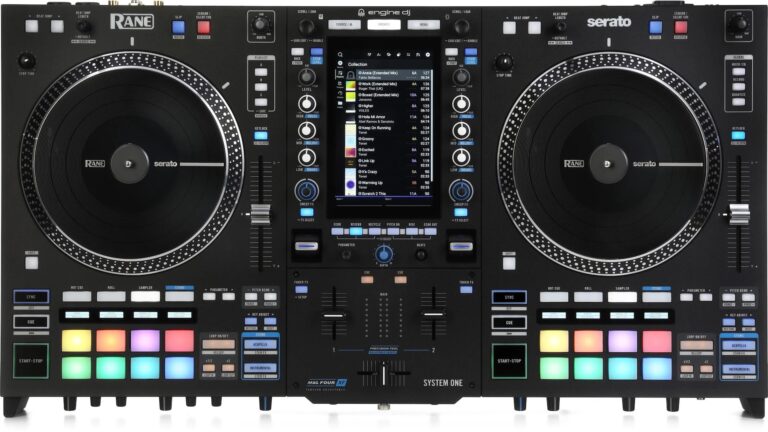
“This is a beast of a unit, and I could definitely see mobile DJs and open-format jocks loving the spinning platters and the all-in-one convenience.”
What do you get when you throw two turntables, a battle-style mixer, and a laptop into a blender and mix it all together? It seems that the folks at Rane DJ took a stab at this very question, and the result of their hard work is the new Rane System One.
This beast of a standalone all-in-one unit arrives with a simple mission: combine the tactile response of motorized platters with the freedom of Engine DJ’s laptop-free workflow. The result is one of the most intriguing DJ products of 2026 and arguably the most performance-focused standalone system currently on the market.
First Look
First impressions-wise, the System One looks and feels like typical Rane hardware. And, that’s a great thing because Rane is no stranger to building serious tank-like hardware. It feels immediately familiar to anyone coming from battle mixers, DVS setups, or even the Rane One controller.
I’m admittedly a big fan of the Rane One controller, so I was very intrigued by the prospect of an all-in-one unit with the underlying DNA and architecture of the Rane One. At 29-inches long and nearly 30 pounds, It’s not the most-portable piece of DJ gear ever built, but every inch certainly feels like it could survive heavy use.
The main thing that separates the System One from other all-in-one units are the two 7.2-inch motorized spinning platters. Rane and its parent company, inMusic Brands, have pretty much perfected these by now. They combine the feeling of manipulating spinning vinyl platters with the limitless convenience of digital music. This feels purpose-built for DJs who scratch: the torque is adjustable, the response is immediate, and the connection between hand and music feels remarkable. What makes the System One unique is that everything happens without a laptop.
The OS
The biggest story here isn’t the spinning platters. Rather, it’s the operating system behind-the-scenes. Powered by Engine DJ, the System One allows DJs to perform directly from USB drives, SD cards, internal storage, and even streaming services via Wi-Fi. Library preparation is straightforward, and the ability to import existing collections from other DJ software makes the switch easy.
The central touchscreen is responsive and well-integrated into the workflow. Browsing tracks, navigating playlists, and triggering effects feels natural and not forced. Unlike some standalone systems where the screen can feel like a necessary compromise, the System One genuinely encourages laptop-free performance.
I had some initial worries that the shift from MIDI controller to built-in processor would potentially introduce latency, but I encountered none during my testing. This is probably thanks to the 8-core ARM processor and the 4 GB of RAM under the hood.
It is still possible to use the System One as a controller for DJ software. Making a debut on the System One is the OmniSource architecture. This allows seamless transitions between various media sources, including local media, streaming services, and software. For mobile DJs and open-format performers who regularly jump between different music sources, this flexibility is a major advantage.
Performance
From a performance standpoint, Rane clearly understands its audience. The Mag Four crossfader feels superb to use, delivering precision expected by hardcore turntablists. Of course, ample adjustment options are present.
Effects implementation is also particularly impressive. There are a ton of built-in effects, opening up a ton of creative possibilities. I’m glad to see effects paddles – something carried over from the Rane One – making an appearance. DJs who enjoy live remixing, transitions, and performance routines will feel right at home.
There are eight bright RGB performance pads below each platter. They’re not the biggest ever fitted to a DJ controller, but I found them easy to use. The 2-channel mixer includes controls for both regular 3-band EQ, as well physical tri-level stems control (vocal, melody, drums). There are also dedicated ways to control stems on each deck section.
Audio quality is exactly what you’d expect from a flagship Rane product: loud, clean, and professional.
I/O
There are dual microphone inputs (both combo XLR/TRS jacks) with controls on the front faceplate. Both mic inputs have a 2-band EQ. Looking at the back of the unit, there’s a universal lockable IEC power cord, USB ports for connecting the unit to either a laptop running DJ software or external storage drives. Thankfully, the different ports are labeled and far enough away from each other that it would be hard to accidentally plug in a computer into a port marked for a storage drive and vice versa. The port to connect to a computer is USB type-C, and there is only one. There’s also an SD card slot for media as well.
The main output comes out via both XLR and RCA outputs. There’s a booth output on TRS jacks, and there’s an auxiliary input on RCAs as well. There’s even a built-in Bluetooth audio output. I would have liked to see a full 2-channel standalone mixer incorporated here, but the one auxiliary input is a nice touch.
Two other outputs worth mentioning are connections to both smart lighting (Philips Hue and Nanoleaf) and SoundSwitch DMX control.
Place in the Market
The Rane System One enters a crowded premium market dominated by standalone offerings from AlphaTheta (formerly known as Pioneer DJ) and inMusic’s own Denon DJ. AlphaTheta’s rekordbox is a more mature and refined software experience, and there are cheaper non-standalone controller offerings on the market.
But, what differentiates Rane is not necessarily its software ecosystem, but its commitment to performance-oriented hardware (especially the motorized platters). This is a beast of a unit, and I could definitely see mobile DJs and open-format jocks loving the spinning platters and the all-in-one convenience.
The Verdict
The System One focuses relentlessly on feel. This is the first standalone system I’ve found that genuinely attempts to satisfy DJs who still judge equipment by how closely it replicates the experience of vinyl. For some users, the 2-channel format may feel limiting compared to four-deck alternatives. But, for scratch DJs and open-format professionals, the focused design may be viewed as a real strength rather than a weakness.
By successfully combining motorized platters, Engine DJ’s standalone ecosystem, professional battle-style controls, and deep performance features, Rane has created a product that fills a gap many DJs didn’t realize still existed. It won’t be the perfect choice for everyone. DJs who prioritize four-deck mixing or club-standard familiarity may look elsewhere. But for turntablists, open-format performers, and anyone who has long wanted a true standalone system without sacrificing tactile control, the Rane System One is one of the most exciting DJ hardware releases of 2026.