


Recently, it was announced that The Knot Worldwide, a global technology and digital media company that operates a portfolio of leading wedding-planning and life-celebration platforms, has entered into an agreement to purchase its smaller peer Zola.
The following is a brief dive into what I see for wedding DJs and other wedding vendors in the not-so-distant future, as a result of this apparent acquisition:
As almost all of you are aware of already, online wedding vendor directories of some type make up a significant part of the wedding marketing mix. Often, these platforms are the primary marketing channel for a lot of DJ companies (for better or for worse). No matter what the type of directory (regional or national), it’s been proven over time that such website portals do actually work… to some extent.
On a global scale, The Knot and Wedding Wire have dominated this sort of wedding marketing for years. Both were launched many years ago, with The Knot publishing in 1996 and Wedding Wire following in 2005. Both portals have similar content – planning tools for brides, registries, e-commerce, and, most of all, vendor directories for brides to “inspect and select.” Notably, almost every wedding directory derives the lion’s share of its revenue in the form of monthly listing fees from said vendors.
When The Knot first launched, it served a definite need within the wedding industry. During this initial phase (1996-2010), theknot.com was widely visited, ad dollars from vendors and advertisers were significant and its corporate reputation was strong. As we all remember though, the early 2010s saw the beginnings of the social-media landscape that exists to this day. First Facebook, then Instagram, Twitter, Pinterest and more… the rise of social media saw brides frequent wedding-planner portals less and less, including The Knot. The resulting decline in its company fortunes led to executive changes and a much greater influence from the Board of Directors as opposed to the original founders (who were all phased out). For The Knot, the private-equity owners were now clearly in charge.
In 2015, The Knot published a site upgrade. Advertised as mobile-first, it was meant to bring theknot.com fully into the modern age of the internet. Unfortunately, the technology was not up to the task, and problems quickly arose, including, but not limited to the following;
- Mismatches in content between the site content displaying on mobile, as opposed to what was seen on a regular desktop browser.
- Problems with ad inventory, in both mismatched ad displays right up to ads dropping off the system.
- Bad “code stacks,” where the only common element binding the portal together is the database, leaving the web application and the mobile app disjointed from each other.
These issues with this new version of theknot.com allegedly led to some unethical (and potentially fraudulent) practices on the part of management. The following have been previously published by industry sources as post-2015 problems:
- Manual revisement of ad-viewing analytics
- Generation of fake leads
- Vendor listings not propagating properly
- Hard-to-cancel contracts
- And more…
These practices accelerated leading up to the 2018 merger between The Knot and Wedding Wire. The working theory is that The Knot wanted to maximize its acquisition price “by any means necessary” before this merger, creating a massive incentive to “cook the books,” so to speak. At that time, no authority took them to task, and the merger took place between The Knot and Wedding Wire.
Enter the rise of Zola (launched in 2013), which became a safe haven for those vendors wishing to escape the clutches of The Knot & Wedding Wire (YK/WW). Once savvy vendors realized through empirical evidence that all was not as advertised at TK/WW, Zola’s vendor directory had a significant upswing in significance, thereby creating a viable competitor to TK/WW. As time has gone on between 2018-2026, that was the status quo… until now.
This past Oct. 14, it was first announced that TK/WW had entered into an agreement to purchase Zola.

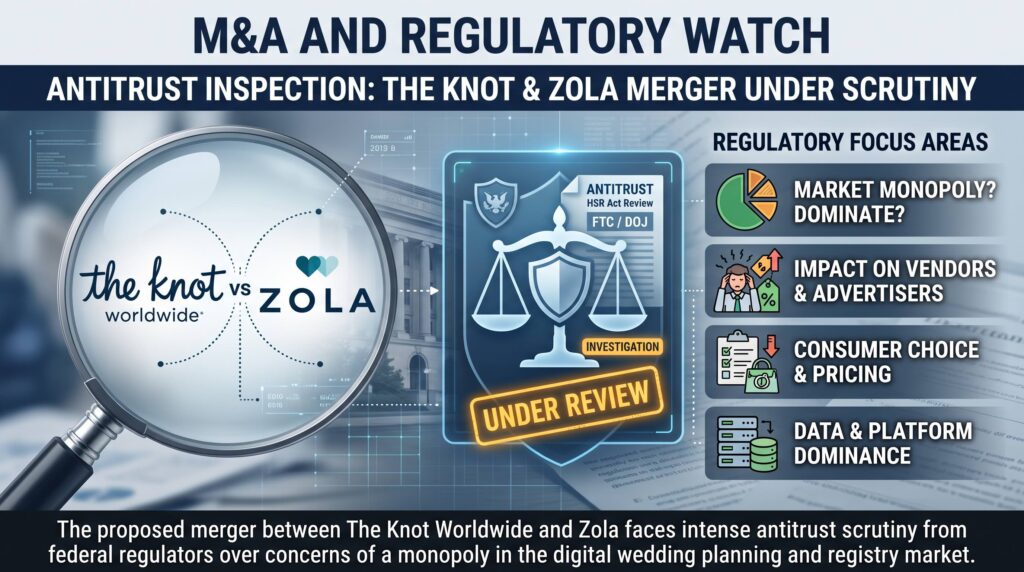
As with any merger of large companies, there are still regulatory hurdles to be cleared. Nevertheless, smart wedding professionals must begin to analyze how this merger will affect their business. We’ve got some historical context here, remembering the corporate behavior from 2018 as a predictor for what will happen with this merger. Accordingly, here’s a summary of adverse effects on the wedding mobile DJ sector, as well as wedding professionals in general.
- Elimination of Direct Pricing Competition
When The Knot and WeddingWire merged, advertising fees for local vendors increased significantly because the two primary platforms were no longer competing. Zola served as a massive safety valve for DJs, offering an affordable storefront. With that direct market alternative eliminated, mobile DJs widely anticipate that advertising costs will rise across all platforms, leaving them with fewer choices.
- Loss of the “Pay-Per-Response” Lead Model
Unlike The Knot (WeddingPro), which locks DJs into strict, expensive year-long contracts ranging from $300 USD to over $1,400 USD a month just for visibility, Zola used a highly favored alternative model. On Zola, basic listings were free, and featured placements were flat quarterly rates or structures where vendors only paid if they actively chose to respond to a pre-qualified couple. DJs fear this transparent, low-risk pricing will eventually be phased out or converted to The Knot’s subscription-based structure.
- Lower ROI & Greater “Ghost” Lead Volume
DJs on community forums like Reddit’s r/WeddingDJs have historically complained that The Knot yields a high volume of “ghost leads” – i.e., automated or highly un-vetted inquiries where couples immediately stop responding, draining a vendor’s time and money. Zola was widely praised for doing a better job of pre-qualifying couples. DJs are concerned that as back-end tech merges, Zola’s lead quality will degrade to match the lower-converting, high-volume automation of The Knot.
- Oversaturation of Local Markets
Because the platforms will be sharing tech and database resources, it is highly likely that directories will become incredibly crowded. For a mobile DJ, standing out becomes a pay-to-play battle. Under a unified monopoly, only the largest multi-operator DJ companies with proper marketing budgets will be able to afford the top “featured” tiers, pushing small, high-quality, single-operator boutique DJs further down the algorithmic search results.
- Pressure to Increase Consumer Packages
Because advertising is one of the highest overhead costs for independent mobile-entertainment companies, a severe price hike on their lead sources forces a choice: absorb the losses or pass them on. This merger will likely create secondary upward pricing pressure, forcing DJs to raise their wedding package rates to maintain their profit margins, making it harder to book budget-conscious couples.
Remember, this deal is not yet final and nothing has changed for Zola or The Knot at present. However, it is clear by now that this acquisition quite possibly will have an adverse effect on the financial outlook for almost all wedding mobile DJ companies. As such, you should all begin considering adjusting your marketing plan moving forward. Don’t get stuck in the middle of this corporate mess; there are strong marketing methods that any DJ company can implement that do not rely on any of these large-scale platforms.
SOURCES:
https://dealroom.co/news/162654-the-knot-to-buy-zola-uniting-two-major-wedding-platforms/
https://www.inc.com/inc-custom-studio/growth-agents-2026/91392597
https://theknotwhistleblowers.com/
https://psst.org/blog/behind-its-pretty-facade-wedding-site-the-knot-hides-a-dark-side
Jordan St. Jacques is the CEO of Ottawa’s Digitera and New York City’s National Proms.