

There are a lot of questions DJs ask before a gig. What should I open with? What music should I bring? How hard can I push the room? Should I take requests? How much should I use the mic?
Those are all fair questions. But I think there is one question that should come before all of them: What am I here to accomplish?
I can play a festival, a wedding, a nightclub or a support set using many of the same skills. I am still programming, mixing, and blending. I am still reading people. Still making decisions about energy, pacing and what comes next.
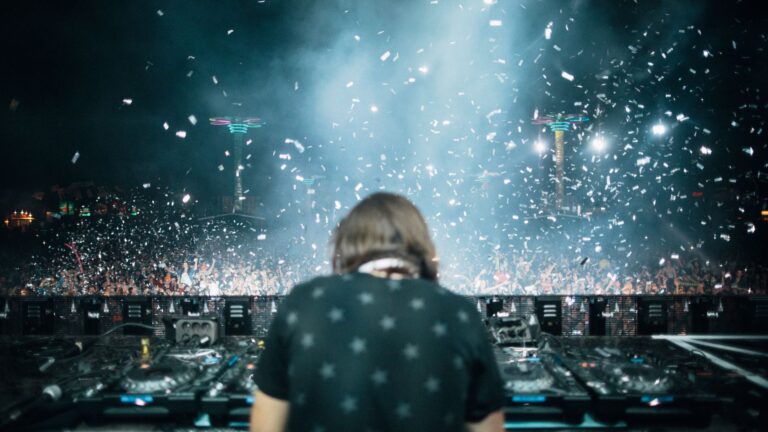
But I do not have the same job in all those rooms. I do not think there is one universal answer to the question, “What is the DJ’s job?” The answer depends on where you are, who is in front of you and why you were hired in the first place. At a festival, the audience has intentionally shown up for a performance. That changes the relationship between the DJ and the crowd.
There is more room to lead, take risks and show a stronger musical identity. Depending on the situation, they may be there specifically to see you, or they may be there to experience the artist you are supporting. Either way, performance is part of the assignment.
That does not mean you ignore the crowd. Reading a room still matters. But the audience has given you more permission to say, “Come with me.”
Now take that same DJ and put them at a wedding. The technical skills may be nearly identical, but the responsibility changes completely. At a wedding, I am helping create an environment around moments people may remember for the rest of their lives. I must understand the couple’s priorities, serve multiple generations, keep the event moving, and know when the music should be the center of attention and when it should simply support what is happening.
Most importantly, I must remember that my own taste is not the most important taste in the room. A song I would never choose for a festival set might be exactly the right record at a wedding because of what it means to the people standing in front of me. That is not selling out. That is understanding the assignment.
Then, there is another job entirely: supporting a band or live artist. Sometimes the best thing I can do is make everything around the headliner better. Keep the energy alive before they come on. Fill the gaps. Complement what they are doing. Make the transitions feel natural.
And sometimes the most professional thing I can do is know when not to make myself the center of attention.
I have seen opening and support acts try so hard to prove themselves that they end up trying to “burn” the headliner. I understand the instinct; I’ve done it myself. Everyone wants to make an impression. But if you were hired to support somebody else, your job is not to win the night from them. Your job is to make the night better and make their set land with more impact.
Nightlife is where this gets even more interesting, because all these roles can start to overlap. If you are the headliner at a destination nightclub, some of the festival rules apply. People may have traveled to see you. They bought a ticket because your name is on the bill. They expect a performance and a stronger point of view.
But if you are opening for that headliner, some of the support rules apply. You still want people to remember you, but the goal is not to unload every weapon you have and leave nothing for the person everyone came to see. Your job is to build and enhance the night, not overpower it and burn it down before the headliner gets there.
Then there is the nightlife DJ who is neither. Maybe you are the resident. Maybe the room itself is the attraction. That brings another responsibility into the picture: the business.
DJs tend to look at the dancefloor as the scoreboard. Packed floor? Great night. Floor clears? Something must be wrong. But a nightclub is also a business, and the DJ is part of that business. Are people staying? Are they engaged? Are they buying drinks? Does the room feel alive? Are we creating an experience people want to come back to next weekend?
Depending on the room, packing every person onto the dancefloor may not even be the most important goal at every moment. Maybe I need to hold the biggest record instead of playing it immediately. Maybe the room needs another 20 minutes before I go there. Maybe the energy needs to breathe instead of constantly climbing.
That is the crossover. A nightclub can ask you to be an artist, a support act, a service provider and part of the business — sometimes on different nights and sometimes in the same night.
That is why I keep coming back to the same question: What am I here to accomplish?
Once I understand that, almost every other decision becomes easier. How much should I use the mic? How should I handle requests? How quickly should I move through music? How far can I push the room? Should I lead the crowd or react to it?
The room starts answering those questions once you understand why you are in it. And none of this means a DJ must lose their identity. For years, I used to joke that I “sold out a long time ago.” What I eventually realized is that adapting to the room does not mean becoming somebody else.
I can still bring my taste, personality, experience and the things that make me recognizable as a DJ. The skill is learning how to bring those things into different environments without pretending every environment is the same.
Being versatile does not mean having no identity. It means understanding your identity well enough to know how to apply it differently. The DJ who only knows how to play one way might be great when the room happens to need exactly that. The DJ who understands the assignment has more options. And the DJ who can understand the assignment while still being unmistakably themselves becomes very difficult to replace.
So, before you build the crate, choose your opener or worry about the perfect transition, ask the bigger question: What is my job in this room?
Understand that first. The rest of the decisions usually get a lot easier.
Just Chris (aka Chris Sweet) is a Fairport, N.Y.-based DJ. Spinning for over two decades, he’s played nightclub residencies, casinos, and festivals across the U.S. and Caribbean. In 2026, he won the “Northeast DJ of the Year” competition and he joined the DJX education program as a panelist. Through this monthly column, The Modern DJ, he explores the changing role of DJs and the realities of building a career behind – and beyond – the decks.