

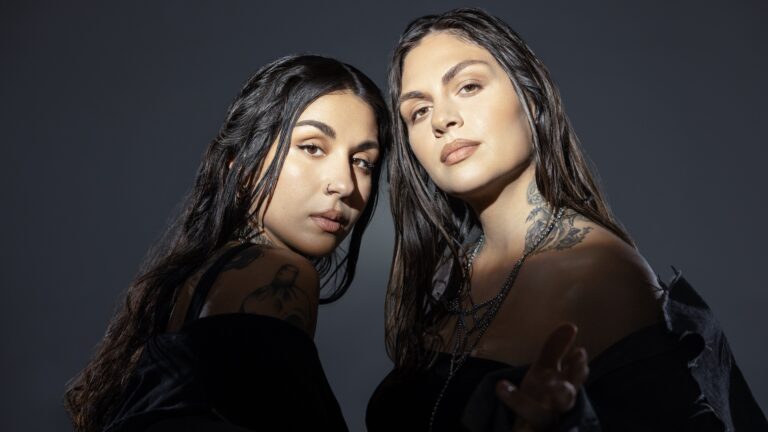
After the powerhouse pair recently returned with a tingly new single, “Crying On The Dancefloor,” Krewella’s Yousaf sisters sat down with DJ LIFE.
When Krewella’s Jahan and Yasmine Yousaf first exploded onto the scene in 2012 with their Play Hard EP, they helped define a pivotal era in dance music. Soon after, their first smash singles, “Alive” and “Live for the Night,” accelerated their success within the circuit. Together, their blend of emotional lyrics and songwriting coupled with their bold stage presence helped propel them to global recognition.
They’ve since dominated nightclubs, airwaves, the charts, digital streaming platforms – and let’s not forget about the top music festival stages: Ultra Music Festival, Tomorrowland, Electric Daisy Carnival, and Coachella.
After years of touring the globe and redefining what it means to be women in dance music, Krewella took a step back to rediscover themselves creatively and personally. During their hiatus, Yasmine dove into other artistic projects and reconnected with her songwriting roots, while sister Jahan spent time studying classical Hindustani vocals and exploring a deeper emotional resonance through her music. The pause was necessary – a recalibration that reminded them of their purpose and passion. When inspiration struck again in early 2024, it marked not just a comeback, but a rebirth.
Now, after the powerhouse pair recently returned with a tingly new single, “Crying On The Dancefloor,” Krewella’s Yousaf sisters sat down with DJ LIFE.
DJ LIFE: How did you spend your time during your hiatus from music?
Yasmine: After our last tour ended in summer of 2022, Jahan and I took an entire two years away from making music together. We had a handful of shows here and there, but our daily and main pursuits went outward, away from Krewella. I went on a creative side-quest that I would love to talk about someday if it ever comes to fruition – I’m a fan of working in silence until I’m ready to share – but it energized me intensely and reinstated a confidence I’d been missing for quite some time. Jahan was working diligently on her voice, working with a classical Hindustani coach, and writing beautiful music in solitude.
DJ LIFE: How did you come back to music?
Yasmine: I hadn’t opened Ableton or even recorded a voice memo melody on my phone in exactly two years when I was struck with the desire in March of 2024. I spent about a month diving back in and wearing my producer/songwriter hat again, until April when Jahan and I decided to officially, but gently, begin working on our next project together. It’s been a steadfast process since then of writing and rewriting until we feel peak authenticity, clearing out old habits and making way for new methods of creation, and sharpening my skills as a producer.
DJ LIFE: What was your approach to “Crying on the Dancefloor,” the first single following your hiatus?
Yasmine: The muse was with us the day we wrote it. In one long session, the song grew to about 85-percent finished. Every songwriting and production choice for that song was something that Jahan and I flowed with. There was little questioning ourselves – which, if you’re a musician, you know is very rare. Lyrically and thematically, we knew it was a special one, because of how it encompassed so much of what we’d been feeling – not only during our hiatus, but our entire career – and decided quickly that it would be our first release of the new era. We’ve had hard dance/techno-leaning tracks on many of our other projects, but this one feels genre-expansive in a way the others may not because of how many different elements we blended together – from the acoustic guitar to the lullaby-esque melodies to the dark warehouse-inspired galloping bass.
DJ LIFE: How has Krewella’s creative process evolved over the years?
Jahan: We’re finding that in the past few years, our studio sessions are feeling more personal and emotionally deep with just the two of us. We still find so much inspiration and growth from collaborating with other producers, instrumentalists, and writers, but being in this intimate setting as sisters is really adding new layers to our relationship and creative flow. Our studio days have become like sister therapy sessions in a way, whether it’s us opening up about family struggles, grief over the state of the world, or reminiscing on our childhood. I also think my mindset going into the studio has also evolved.
DJ LIFE: How so?
Jahan: I used to bring so much pressure to the studio to make a “good song” and would feel anxious if I didn’t feel like I was contributing enough or offering anything valuable. At this point, we’ve found a way to find more joy in creating without worrying about the outcome and also accept the moments where the creative juices are dry, because even trees have to take a break from producing fruit – remembering we’re a part of nature can be so humbling.
When I picked up guitar in the pandemic, I discovered that having the freedom to let the voice flow with chords really supported the songwriting and lyric process. A few of our upcoming songs actually started off in this way, like a folk/pop song written on a bed, which completely transforms once we start building production around it. And one of our tried-and-true methods of writing over the years that we still use is looping a segment of a beat for several minutes at a time and spitting a bunch of gibberish over it. Whoever is outside the recording booth is usually listening for nuggets of gold that we’ll extract from the recording and to start crafting a song around. Having that time to purge whatever is in the subconscious can be so cathartic, too, because sometimes it’s a lot of garbage or self-consciousness mutterings that you need to get out of the system before you really start feeling free with your expression.
DJ LIFE: Career-wise, Krewella seemed to rise relatively quickly. What did you learn from that experience?
Jahan: We started in 2007 as a side project, while we were in school and had other jobs, and it was actually quite some years of incubation. When we started finally releasing music in 2011, it did feel like a quick escalation in growth of our fanbase, public attention, and touring opportunities – and, of course, pressure and stress came with those blessings. It felt like we were on a high-speed train that we couldn’t stop… like once we started gaining momentum, the thought of pausing to rest, or slowing down from touring to process life and have personal time, felt like it would ruin everything we had worked for.
DJ LIFE: The dance-music industry was going full-speed at that point.
Jahan: People were in our ears, and the team around us at that time were advising us to say yes to every opportunity – and that we had to completely milk that moment of EDM, because we were being warned there wouldn’t be longevity. We were so naive and inexperienced, so we didn’t know there was any other way to do this career. We crashed hard, and it really humbled me… it forced me to look at how so much of my self-worth was based on what people thought of Krewella, how much music we were releasing, and how productive I was. In a way, I’m grateful for those low moments because we learned to take better care of our health, started working on our relationship as sisters, and re-connected with other parts of us outside Krewella, like our Pakistani roots. We have more respect for the natural process of ebbs and flows/highs and lows in a career now. Also, one of the biggest learning experiences has come from our experience with our current management, receiving their support, patience, and trusting Yasmine’s and my instincts, even if that means saying no to an opportunity or taking a pause.
DJ LIFE: Who were some of your earliest DJ inspirations? Which DJs do you respect or admire most today?
Yasmine: Some of our favorites from 10-15 years ago are still our favorites today. When Netsky’s album 2 came out in 2012, Jahan and I could not stop listening. It still holds up today, and he’s still one of my favorite artists with his releases since then. Pendulum’s 2009 Immersion will go down in my greatest-of-all-time albums – you can hear so much inspiration from this in our first few projects – and when Knife Party emerged in 2011 from that group with 100% No Modern Talking, our vision of where we wanted to take our music changed forever. I can still cite these albums as bodies of work to listen to when I’m feeling creatively stuck.
DJ LIFE: What musical elements are you listening for?
Yasmine: I’m a big fan of artists who understand the song as a whole – not just a build into a drop and rinse and repeat –but arrangements with a journey, incredible topline, even if it’s a few lines, and an understanding of proper dynamics of energy. Today, some of our favorites would have to be Sub Focus, CloZee, Koven, Knock2, Yellow Claw, Chase & Status, and I have to shout out my dear friend Mutrix – one of the greatest producers/sound designers out there – who has emerged from a very long hiatus from the industry to finally release music again.
DJ LIFE: How would you describe your DJing style? How do the two of you work together in the booth?
Yasmine: Our style is the crux between chaos and release. We try to play as much of our own music/remixes as possible and, as the years go by, we flip and bootleg things to keep it fresh for not only ourselves, but the fans who have seen us countless times. Anyone can DJ solo, but I’m grateful we have each other for the moments such as when tech issues arise, when we do extreme tempo jumps like 100 to 150 bpm [laughs] – and to keep our energy at a 10, so we can share the best of ourselves with the crowd in front of us.
DJ LIFE: On the DJ front, what gear do you prefer and why that choice?
Jahan: Pioneer CDJs, Pioneer DJM mixer, USBs. Pioneer is the industry legend, tried-and-true, and reliable.
DJ LIFE: How do you balance your set between playing Krewella material and tracks by others?
Yasmine: We try to keep the balance as best as possible, for the Krewella fans who know every one of our songs and for the electronic fans who might only know one or two. We pretty much only play tracks of other artists that we personally love and would also want to hear at a show.
DJ LIFE: Who are some producers/artists that you like to play the most?
Yasmine: Nazaar, Rohaan, Toneshifterz, Madgrrl, RL Grime, Juelz – to name a few.
DJ LIFE: From a live standpoint, what are some songs you think you’ll always include in your sets?
Jahan: Our classics from back in the day, like “Enjoy The Ride,” “Live For The Night,” and “Alive,” to bring some nostalgic magic to the night. “Beggars” and “Ring Of Fire” for a mosh pit. “Team” and “Alibi” for an uplifting downtempo break to hug a friend. “Ghost” and “New World” for the bad bitches. “Come And Get It” to feel 21 again.
DJ LIFE: What’s in your studio?
Yasmine: Ableton Live is king, in my personal opinion.
Universal Audio Apollo x6 interface. Audeze LCD-X headphones or Airpods Max for on-the-go, Neumann KH 310 monitors and KH 750 sub at my home studio. My partner and I built our home studio from the ground up and it’s my favorite place to work in the world. We’ve recorded most of our vocals from the last five years on the Sony C-800G mic, Manley Reference Cardioid Tube mic, or the Slate Digital VMS. The Manley is the best, though, for the range in frequencies of both mine and Jahan’s voices.
DJ LIFE: What about plug-ins?
Yasmine: My non-negotiables for plug-ins, outside of flexing the Ableton stock ones as much as possible: Xfer Records Serum; Output’s whole lineup – amazing for getting yourself out of writer’s block; Waves Ultimate Bundle – vocal-chain madness; Kilohearts, but specifically their transient shaper – none is better; Baby Audio’s Smooth Operator and Humanoid; iZotope’s Ozone and VocalSynth; Cymatics Shockwave for the best 808s and Dark Sky for incredible texture layering; Dada Life’s Endless Smile for that classic riser/sweep energy; Valhalla’s lineup for unrivaled reverb; Cableguys/Nicky Romero’s Kickstart for the best sidechaining of your life; Soundtoys entire lineup, but Little AlterBoy is peak; and, of course, FabFilter Pro-Q 3 and 4 and Pro-L2. You don’t need any of these, but they make the process of creation more exciting for sure.
DJ LIFE: In your estimation, how has the industry changed since Krewella broke out?
Jahan: It feels like anything goes now. Less rules around how to release. Songs are shorter for TikTok brain. More artists using their voices online to be vulnerable or increase visibility for causes, like our country’s role in the genocide in Gaza, climate injustice, or mental health. There’s more raw, unfiltered expression – not everything needs to live up to a standard of sounding or looking super-polished and professional. Anyone with an outdated iPhone and basic gear can have their creative work appreciated online. Because of the accessibility to a platform for more people now, there’s less gatekeeping. It feels both messy and free. I love and I hate it.
DJ LIFE: How’s that?
Jahan: I feel like I’m in a state of surrender, and it feels pointless to complain about what I cannot change, like the omnipresence of AI and the unpredictable algorithm. Because of the noise and chaos, we feel the importance of staying rooted in nourishing our creative spirit and connection to nature, and how it takes even more discipline these days to maintain a sense of humanity amidst the distractions. Despite the erratic trends in the industry and uncertain state of the world, we both feel that dance music is here to stay. Humans will always want to connect on the dancefloor.
DJ LIFE: What advice would you give to aspiring DJ/producers?
Yasmine: Start as soon as possible, and if you’ve already started, just release music and get out there. The more time you give yourself to experiment, grow, release your music into the world and get to the next level, you will 100-percent have less regret in your life. The dream is still alive and well, if not more now than ever. More help and tools, more connectivity online, more fans who are listening to electronic music, more hunger for authentic artists who love to make and DJ this kind of music. The golden era of EDM may forever be talked about as 2010-2014, but we’re in a wave currently that I believe will be talked about the same way in 10 years.
DJ LIFE: What are three of your most-favorite venues?
Jahan: Bootshaus Cologne is always a riot with the rowdy German crowd and insane sound system. SEL Octagon because we’re in love with Tokyo, and it’s an intimate venue where you can see every person’s face in the crowd. And the epic production and artistic design of Tomorrowland in Belgium is so magical. We can’t wait to play there again. Fingers crossed summer 2026.
DJ LIFE: What does the rest of the year have in store for Krewella?
Jahan: We’ve always hyped up stuff we’re working on, but at this point we’re just keeping our heads down and truly surrendering to the creative process by taking our time with a body of work. I know the vagueness isn’t exciting for fans to hear, but we want them to know we’re quietly working on very loud music [laughs]. But our “krew” can expect a melodic drum-n-bass single out before winter.
DJ LIFE: Any long-term, career goals?
Jahan: Continuing on the path of expressing ourselves more authentically into the world. Aligning our values more with our career, like finding a way to re-invent the merch business with a more environmentally sustainable method by creatively up-cycling old materials. Partnering with more South-Asian artists and continuing to build a relationship with Pakistan through touring and connecting with musicians there. Building a community where other artists can feel mutual support and emotionally held on their creative journeys. And overall, just becoming a more bold, risk-taking artist that is not limited by expectations or preconceived ideas of Krewella.