

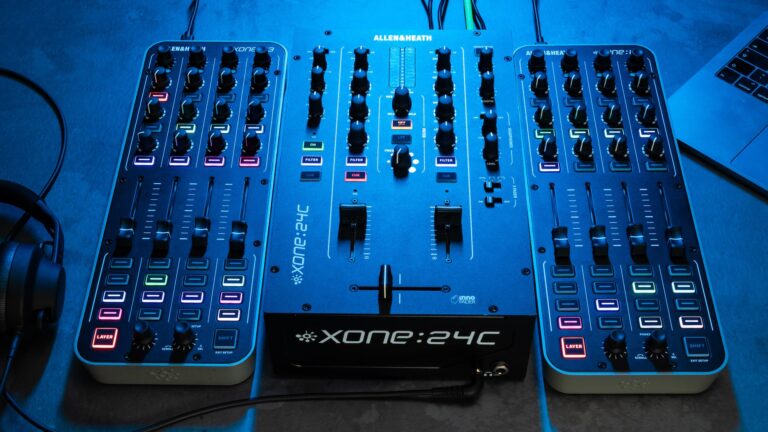
“Where the Xone:24C separates itself from a lot of comparably priced analog mixers is with that suffix: the C.”
Allen & Heath, the venerable U.K.-based maker of audio gear for live sound, audio production, and the DJ market, doesn’t just make mixers; it has played a key role on the music scene for decades, building its reputation on robust design, thoughtful layout, and a certain no-nonsense British engineering sensibility.
One could argue that the Xone DJ-mixer line has earned its own type of mythology because it chases feel and sound, not just features. The Xone:VCF filter is a great example of both; a voltage-controlled analog circuit that’s more than just some sort of audio garnish.
In any case, Allen & Heath and the Xone line hold a special place in my heart. One of my earliest serious investments in my DJing work was acquiring a Xone:3D shortly after release. When they came out over 20 years ago, it felt genuinely groundbreaking: a proper analog mixer at the core, with MIDI control and a built-in audio interface meant to bridge the physical and software worlds in a way that was still new for working DJs.
So where does the Xone:24C land in that legacy? It’s not trying to be a flagship booth monument like a 92 or 96. It’s doing something more practical: taking the essential “Xone-ness” (analog path, proper filter, solid fader feel) and putting it into a compact, modern hybrid mixer built for real-world home rigs, small rooms, and mobile setups.
A Little History: Allen & Heath began with the Xone:22, which then graduated to the Xone:23, and now we have this third mark of the two-channel units, the Xone:24, a 2+1, all-analog DJ mixer. In creating the Xone:24C, Allen & Heath kept that analog foundation, but added a built-in USB-C audio/MIDI interface and a powered USB hub, so it can act like the connective tissue of a hybrid setup.
That “C” isn’t a minor suffix, it changes the use cases:
- Streaming and simple recording: It can route a clean master feed straight to a computer without extra hardware.
- DVS workflows: It supports a DVS-oriented routing mode, intended for timecode control while still mixing through the analog channels.
- DAW/capture workflows: There’s a DAW mode aimed at recording channels in a way that supports post-editing and rework.
If you want a pure, compact, analog mixer and you already have a favorite interface, the Xone:24 is the cleaner buy. But if your set-up lives half in a laptop, the 24C is the one that actually matches how a lot of DJs work in 2026.
First Impressions
At just under $700, the Xone:24C sits in a very competitive slice of the market: serious two-channel mixers where build quality and sound matter, but you don’t necessarily want to pay flagship prices. In that context, the price looks reasonable, especially when you compare it to common alternatives.
The 24C’s sales pitch is also refreshingly focused: two main channels plus an aux channel, analog signal path, Xone:VCF filter, an Innofader crossfader, and a connectivity story that’s clearly designed for modern laptops and USB-C devices. It’s compact, but it doesn’t look like a “budget” mixer trying to cosplay as pro gear. Users who’ve gotten hands-on time with the 24C tend to describe it as minimalist, efficient, and solid, with a feel that’s clearly in the Xone family, even if it’s not as luxurious as a 96. That’s a take I agree with.
On the 24C you get a 3-band isolator-style EQ and the Xone:VCF with high-pass and low-pass modes, frequency sweep, and resonance control. The filter is still the headline feature because it enables transitions that don’t rely on onboard digital effects. You can ride the cutoff, lean on resonance for tension, and do clean “subtract-and-swap” moves. Also worth calling out: the 24C includes a master insert/FX loop on the rear panel.
Where the 24C separates itself from a lot of comparably priced analog mixers is with that suffix: the C. The built-in interface is specified as 24-bit/96kHz, and the user guide describes it as a 12-channel (3 stereo-in/3 stereo-out) USB sound card, with multiple routing modes (Stream, DVS Pro, and DAW).
Hands-On
DJ mixers are famously hard to review because the best ones don’t scream for attention; they simply disappear. What I’ve personally found as I use the 24C is that it aligns well with the common threads I’m seeing, in that people seem to like the sound quality and analog vibe; it has a minimalist, easy-to-learn layout; and it offers functionality that’s at home across both traditional and hybrid set-ups, making it feel like a “small rig centerpiece,” not just a mixer.
What tends to get flagged as shortcomings I’m not sure I’m quite as on board with:
- Metering preferences. Some users want more granular per-channel metering than a “signal-present”-style approach. (Personally, I tend to use my ears as my judge.)
- No onboard digital effects. If you’re coming from a traditional-flagship-type DJ mixer, this is a different philosophy. (For me, built-in effects tend to be a bit gimmicky.)
- Two-channel limitation. That’s not a flaw so much as a constraint. (In my view, if you want to run three or four decks all night, you should be shopping in a different aisle.)
One thing I found myself not loving are the faders. They have a great deal more lateral movement than I like, which seems to be quite common among DJ mixers at this point, the makers of which are no doubt choosing from a limited range of the same basic off-the-shelf component options.
In any case, with a real set-up, the 24C looks best when you lean into what it’s made for: two strong sources (turntables or media players), plus a flexible third lane via Aux or USB for a sampler deck, a drum machine, or other source. The user guide even spells out those kinds of Aux USB uses (sampler deck, third virtual deck, FX return, separate app audio). In my mind, that’s a modern hybrid sweet spot.
Conclusions
At just under $700, the Xone:24C feels appropriately priced for what it is: a compact, pro-grade analog mixer with a genuinely useful, modern USB-C implementation.
It’s not trying to win a spec-sheet war with onboard FX and performance pads; it’s trying to be the mixer you buy because you care about sound, transitions, and tactile control, and because you want your laptop to integrate cleanly without turning your booth into a cable-management horror film.
If you want an affordable entry into Allen & Heath’s Xone ecosystem and you mostly mix with two channels, it makes a strong case. And if, like me, you still have a soft spot for the “hybrid-revolution” era that the Xone:3D helped define, the 24C feels like a modern, simplified descendant of that same idea: take analog seriously, then make the digital integration clean, instead of overkill.