

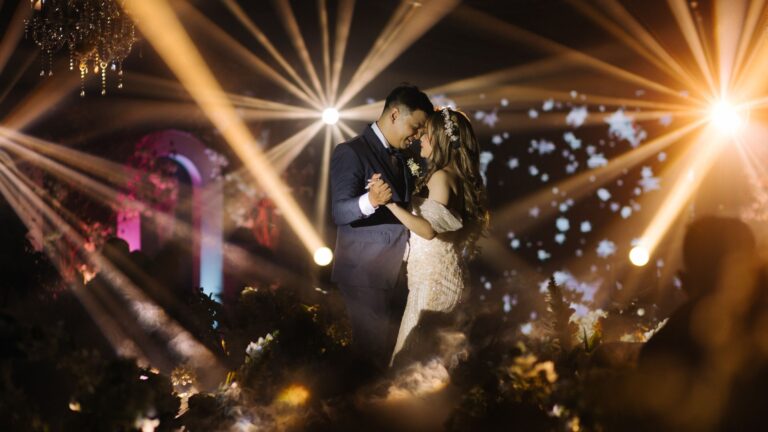
“Once the reception is underway, the guest experience is being driven in real-time, and the DJ is at the center of that.”
During COVID, when much of the wedding industry came to a standstill, many businesses (like DJs) had to decide how to respond.
Some chose to wait it out and conserve energy until things returned. Others stepped into a more active role, trying to help the industry think through what would come next. That was the lane where Alan Berg and I found ourselves. We began hosting a series of webinars to help wedding professionals position themselves to come back stronger when events resumed.
One of the topics that quickly surfaced as something people genuinely wanted to understand better was the relationship between venues and vendors. We brought in panelists representing different types of venues – venue groups, independent properties, all-inclusive locations – and the response was significant.
We had well over a thousand businesses registered. That kind of turnout tells you something: It tells you that this isn’t a fringe conversation. It’s something that sits at the center of how many wedding businesses either grow or stall.
If you’ve spent any time in the DJ world, you already understand the weight of venue relationships. For many DJs, being a preferred vendor at one or more venues is not just a nice addition to their business – it is a primary driver of consistent bookings. There are DJs reading this right now whose calendars are largely filled because of the trust they’ve built with a handful of key venues over time.
When you step back and look at how couples plan, it makes complete sense. The venue is often one of the very first major decisions they make after getting engaged. In many cases, it’s the anchor that everything else is built around. Before they fully engage with DJs, photographers, or other vendors, they tour spaces, ask questions, and imagine their day inside those walls. That puts the venue in a position of early, significant influence.
There are even earlier touchpoints that most wedding professionals don’t fully consider, like jewelers. When someone is buying an engagement ring, there is already an opportunity for recommendations to begin. It’s an interesting, largely untapped layer, but it reinforces the idea that influence in this industry starts earlier than many assume.
Bringing it back to venues, what stands out to me is how often DJs underestimate the role they play in an event’s overall success. I was reminded of this recently during a visit to a venue. I saw the space during the day, without any set-up – no lighting, no decor, no tables dressed. It was a perfectly fine room, but it didn’t leave much of an impression. I even suggested to the venue that keeping certain areas styled year-round might help couples better visualize what the space becomes.
A few weeks later, I attended a wedding in that same room. The transformation was obvious, but what really shifted the experience wasn’t just how the room looked. It was what happened once the event began. The DJ engaged the crowd almost immediately, the dancefloor filled, and the energy in the room changed. In that moment, the visual aspects of the space became secondary. What people were responding to was how the event felt.
That’s an important distinction. The venue plays a critical role in getting the booking. It shapes the initial impression, the logistics, and the flow of the day. But once the reception is underway, the guest experience is being driven in real-time, and the DJ is at the center of that.
Knowing that, it’s surprising how little DJs communicate their expertise in relation to specific venues. You’ve worked in these spaces. You understand the nuances. You know how the room responds, how the timeline plays out, what tends to work, and what doesn’t. That kind of experience has real value to a couple, but it’s rarely positioned in a way that helps them recognize it.
This is where preferred vendor relationships come into sharper focus. Being recommended by a venue is not the same as appearing on a wedding-advertising directory or displaying a badge. It carries a different level of credibility. From the couple’s perspective, this is the place they’ve chosen to host one of the most important days of their lives. If that venue is comfortable recommending you, it reinforces the idea that you are a safe and trusted choice.
At the same time, the way those recommendations are delivered can vary widely. Some venues provide a printed list. Others feature vendors on their website. Some make direct introductions. Others mention names more casually during conversations. Regardless of the format, a common challenge tends to follow.
Timing.
Couples often book their venue well in advance. After that, there can be a pause in their planning process. Months go by before they actively start researching other vendors again. When they return to that process, they are often approaching it through search – Google, AI-driven results, wedding platforms, social media. The venue’s original recommendation may not be top of mind anymore.
This creates a gap that DJs can either ignore or address intentionally.
If a couple lands on your website during that later phase and sees a clear connection between you and their venue, you are effectively reintroducing something that already carried weight for them. It brings back a sense of familiarity and reinforces trust at a moment when they are actively evaluating options.
That only works if the connection is visible.
It should be present on your homepage, on your about page, and on your wedding-specific content. It should be easy to recognize without requiring the visitor to search for it. At the same time, it’s important not to dilute that message by mixing it in with unrelated credibility signals, such as corporate client logos. Those belong in a different context. Venue relationships should stand on their own because they speak directly to the wedding experience.
Even at that level, simply showing the association can have an impact. It can shorten the path from inquiry to conversation by answering an unspoken question the couple may have about whether you are familiar with their venue.
There is, however, a deeper level that is often overlooked.
Rather than stopping at a list of venues, there is an opportunity to build meaningful content around them. This could take the form of a dedicated section of your website where you highlight venues you regularly work at, not just by name, but with context and insight. You can speak to what the experience is like in each space, how the room tends to flow, what couples should consider when planning there, and how entertainment plays a role in that environment.
This shifts your positioning. You are no longer just presenting yourself as a DJ available for hire. You are demonstrating that you understand how weddings function within specific venues.
Taking it a step further, instead of linking directly out to a venue’s website, you can create your own pages or posts focused on those locations. Including photos, videos, and real examples of events you’ve been part of builds a stronger connection. When a couple who is considering that venue finds your site, they are not just seeing a name they recognize. They are seeing proof of your experience within that space.
That kind of familiarity carries weight. It reduces uncertainty and helps them picture what working with you would feel like in a setting they’ve already chosen or are seriously considering.
There is also a longer-term benefit to approaching it this way. While much of the conversation around venue relationships focuses on receiving referrals, there is value in thinking about how you can contribute to those relationships as well. If your content and visibility occasionally lead a couple to inquire about a venue, you have created a scenario where you are not only benefiting from the partnership, but also adding to it.
That changes the dynamic. It strengthens the relationship in a way that goes beyond being one of several names on a list.
None of this requires a complete reinvention of how you operate. Most DJs are already doing the foundational work. They are performing well, building relationships, and earning recommendations. The opportunity is in how that work is presented and extended through their website and overall presence.
When that connection between your experience and the venues you work at is made clear and intentional, you are no longer just another option that a couple happens to come across. You become part of something they already trust, and that changes how they view you before a conversation even begins.
Brian D. Lawrence is the co-author of “From Browsing To Booking” and owns a wedding and event industry-focused web design and SEO agency. At DJX’26, he’ll present his tutorial,“From Browsing to Booking: The New Age of SEO for DJs.” Please visit www.brianlawrence.com.