


Legendary French Talent Joachim Garraud Stays Future-Forward With New Spatial-Audio Tech, While Reviving His Past with a Truly Massive Autobiography.
Miami, Fla. – Sometimes our annual trip to Miami Music Week provides an editorial opportunity that we wouldn’t always find during the regular course of running a magazine. Like Amsterdam Dance Event week, nearly the entire DJ world visits Miami each March, and this time, we were lucky to connect with one of industry’s rare talents: Joachim Garraud.
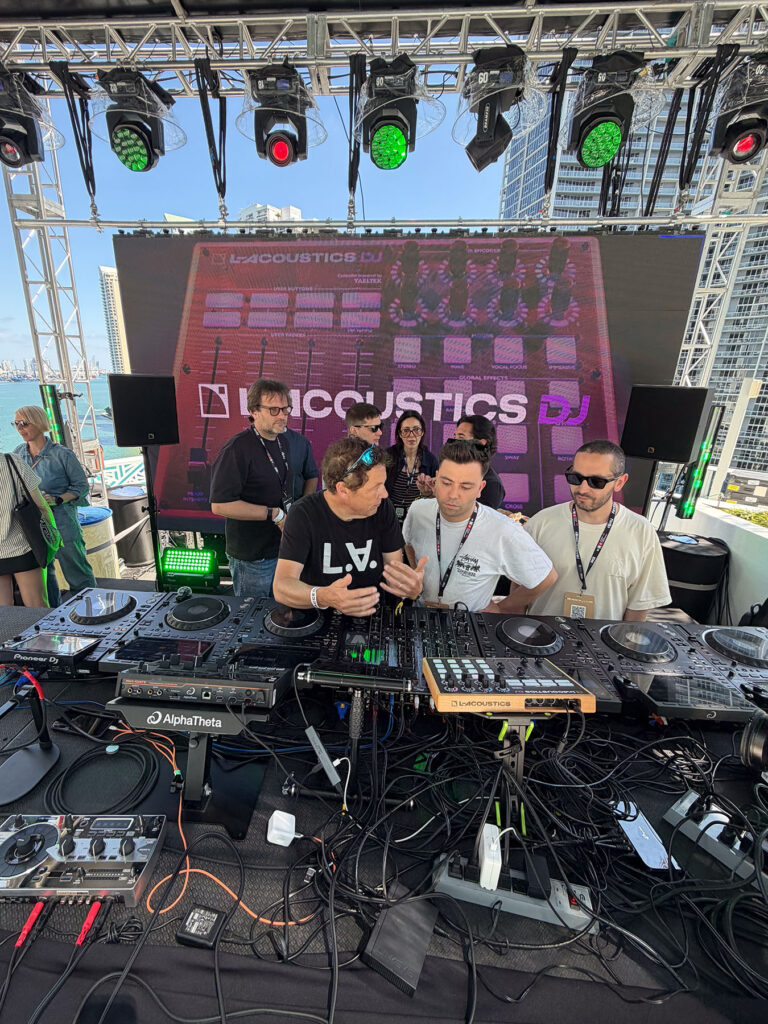
A DJ, remixer/producer and collaborator to the stars, Garraud has been a beta tester/sought-after R&D guy for a variety of software, pro-audio and DJ brands. In Miami at Winter Music Conference, he was showing off L-Acoustics DJ, the French company’s spatial-audio solution for nightclub jocks. So, once I’d secured his attention in the bowels of Kimpton Epic Hotel, we discussed that emerging technology, among other topics, like his new 532-page, coffee-table-sized autobiography. Called “I Love My DJ Life” – and currently available in French – the massive effort details his amazing 40-year DJ career and includes QR links to exclusive music and more. I’ve never seen anything like it.
Truth be told, Garraud has been one of my “white-whale” interviews ever since I caught his act in 2010 at an ultra-glitzy nightclub in Monte-Carlo called Jimmy’z during a now-defunct event called the Monaco International Clubbing Show. To the regular convention-goers grooving on the dancefloor, not to mention some real oligarch types acting the fool in the VIP areas, he was playing a blistering techno set wearing a Space Invaders mask, while I was spending 40 euros for two bottles of Heineken… but that’s another story. It was such a weird scene, I couldn’t help but love it.
Garraud, it seemed, wasn’t one to court the press either. He was confident in his abilities and his level of popularity (which was way bigger in Europe than the States). Of course, that made me more intrigued.
Not all DJs will know Garraud just from looking at him – as mentioned, he often wears disguises – but they definitely know him from listening to his music. Not only was the Frenchman a collaborator on global smashes like “World, Hold On” with Bob Sinclar and “Love Is Gone” with David Guetta, his production credits include stars in and beyond clubland – from Paul Johnson to David Bowie, from Deep Dish to Jean-Michel Jarre and more. His work in the techno world has been prolific as well. (Check out some of his frenzied tracks like 2009’s “Space Invaders Are Back,” 2011’s “Dark Signal,” and 2019’s “3ACID3.”) He’s a complete original.
So, here’s our conversation with Joachim Garraud:
DJ LIFE: What are your thoughts on spatial audio in nightclub applications, and tell us about the L-Acoustics DJ sound solution in particular?
Garraud: Right now, L-Acoustic DJ uses your stereo mix and brings it to another level. It just converts to an immersive mix, and this works in real-time. You don’t have to send any data in the cloud – this is local only. It brings a better experience for clubbers, because you’re not just listening to the music, you are inside the music, and the difference is huge. This is immersive – and that means you are in the middle of the music.
DJ LIFE: As a DJ, what are you doing?
Garraud: I’m able to separate the stems live and I’m able to move my vocal around you or make the drums go back and forth, front up, down, behind you. So, it’s 360 – exactly the quality of the theater when you go to see a movie.
DJ LIFE: How is that accomplished?
Garraud: The signal will go out from your mixer, and that signal is a stereo signal. So, it could be from any source. It could be vinyl turntable; it could be a live saxophone or a singer. This signal goes straight to the L-Acoustics processor called P1, and this processor separates the stems live, and then out from your processing you go straight into your multiple speakers. I don’t know how many speakers you need – at minimum, four, but six is better, and 12 is the luxe spectacular! But it goes straight from the P1 to your speakers, and that’s it.
DJ LIFE: No special considerations for a producer to prepare music for spatial?
Garraud: No, nothing… no need for a special mix because you’re using your stereo track. You’re just doing everything on the go, you improvise, and using the L-Acoustic system to separate your stems.
DJ LIFE: I went to a club in Amsterdam called The Other Side, which has the system with multiple loudspeakers around the room, so I got the club experience. It was unique, and very fun to walk around the dancefloor.
Garraud: Yes, this club in Amsterdam is one of the best integrations of L-Acoustics DJ. What makes the experience unique is to be in the middle of the crowd, because you have the very precise sound. Having the sound coming from multiple speakers is better two speakers because you have less fatigue in your ears. The balance is better for the sound. Having the sound coming from everywhere is better than having the sound coming from one source.
DJ LIFE: With this system, DJs have a variety of effect choices to use – mood, intensity, riser, etc. Explain how an effect is useful for how you DJ.
Garraud: Let’s say, I want to increase the build-up before the drop. So, I’m doing an audio loop… I can make it come around to you faster and faster and it gives you the impression there’s something alive. I’m using these effects to make my build-ups stronger and – boom! – I go to the drop.
DJ LIFE: As it relates to spatial audio, what do you see in its immediate future? What improvements are necessary?
Garraud: Yes, the first one is to be linked with lighting systems because if you’re moving a sound around you, and you have the lighting following the sound, that makes the experience much better. It would be for all your senses. Also, having different effects is important, because you can’t just have the music turning around and around for four hours non-stop. So, I think you need to have some special effects, like the build-up I just told you, but then after that, you need to have very smooth effects, moving just a little bit around you. For example, the vocal might be moving up to you and back to the original position.
DJ LIFE: This book is quite an endeavor. How did you approach the book project, and what did you want to accomplish?
Garraud: I wanted to transmit to the new generation the path and the journey of 40 years of the DJ. When I started in 1984, nobody wanted to be a DJ. But today, 2026, everybody wants to be a DJ, so why? The answers are in the book… to explain how the technology changed our life, how music changed our life, how the status of the DJ changed from nobody knows the DJ to superstar DJ. In 1984, I was playing in my parents’ garage for eight friends and 25 years later I’m playing Coachella for 80,000 people, just to explain the story, because the gap is huge. So that’s why the book is huge, because I have so many stories to explain.
DJ LIFE: The book is also uniquely interactive with loads of QR codes…
Garraud: Yes, you scan the QR code and immediately you have a movie of David Guetta and Bob Sinclar in my studio in Paris, making music with a track never released. It’s just to explain that, before being professional, we were all amateurs of the music, but we stayed in love with the music, so that’s why the book is huge.
DJ LIFE: Tell me about the LA Good Vibe mobile studio…
Garraud: I’m in love with the music, the trip, the desert, and the wild west. In 2006, I went to my first Burning Man in Nevada, and I felt in love with the BLM – Bureau of Land Management – and all those places you can go with only two rules to respect: leave no trace and no more than 14 days in the same place. Then, in 2020 we had COVID and, for the first time, I had no travel or shows, so I decided it was time to buy an RV, a 2009 Fleetwood 36-feet long, and to convert this RV to a solar-powered recording studio on wheels.
DJ LIFE: And that’s LA Good Vibe…
Garraud: Yes, and I’m using this recording studio to bring bands and DJs into special locations, because location gives you the inspiration. You’re not producing the same music when you are in front of the Pacific Ocean and you can hear the waves, compared to being in the middle of downtown LA with the millions of cars running in front of your window. The experience comes from the location, and that’s why I’m using this RV as my recording studio, and I’m bringing artists into the special place to bring them special inspiration.
DJ LIFE: Is it a commercial space?
Garraud: No, it’s not a commercial space – it’s a very private space. As a publisher and producer, when I’m falling in love with new talent, I’ll send an email saying, “Hey guys, I want to produce your next song or your next track. Come to my LA Good Vibe recording studio. You’re not going to pay anything. This is for free.” I just keep the publishing because I’m going to be your publisher, and we’re sharing the production part. But this is the good way help the new generation, because I give them a professional recording studio and also a beautiful location to have amazing content for Instagram. With the drone, when you are in the middle of nowhere… this is crazy.
DJ LIFE: You came up from a very traditional musical background. When you were very young, you were in conservatory, so tell me a little bit about your first musical influences.
Garraud: That’s funny, because these are exactly the first pages of my book. Usually, your first influence is your parents’ records, so I was lucky to have a mother who was a modern jazz dance teacher. She had a very small non-profit association in France and every year she tried to invite a famous dancer to come to France. When I was about 12-years old, the dancer Lynn McMurrey came to visit – he’d been in many shows and he came with a lot of vinyl. So I was listening to The Temptations’ “Papa Was a Rolling Stone,” Laurie Anderson’s “O Superman.” So, at 12, I discovered this music, plus my parents had Jean-Michel Jarre’s Oxygène, which was a huge thing. So those were my three records.
DJ LIFE: That’s a pretty good start.
Garraud: A funny thing in the book… I have a video of Jean-Michel, Laurie Anderson, and I in the same recording studio because I was producing a track for Jean-Michel with Laurie Anderson, and that day I was crying because I made a gigantic loop of 25 years. I have goosebumps just re-telling the story.
DJ LIFE: How did you become so engaged in electronic music?
Garraud: So, I had this classic music education, learning piano and drums at school. But when I turned 16, I fell in love with the computer, and my first computer was the TO7 from Thomson. That was the beginning of something that changed my life, music by computer. In 1984, I discovered MIDI – so I was able to merge two hobbies.
DJ LIFE: How did you pursue that?
Garraud: I remember in ’85 my first track recording with a computer was a cheap sound with only 8-bit, only four or six seconds, was mono. But that was my first track producing with sampling. That’s why I bought Atari, because Atari was the first machine having the MIDI connector by default. There was a software called ST Replay, and it was the first sampler ever, eight seconds/8-bit. After that, I bought an S1000 from Akai, and that changed my life, because there was a real sampler in stereo.
DJ LIFE: The early ’80s was very interesting time for all that technology. What music were you listening to?
Garraud: Yes, so rich! Prince! And I’m still listening to Prince. In France, Jean-Michel Jarre and Kraftwerk for the German part. I was lucky to be a teenager in the ’80s because it was such a rich period in terms of creativity.
DJ LIFE: How did the DJing come about?
Garraud: At first, as a DJ, I started to play records like The Cure, Depeche Mode, Kool & The Gang, funk, because I was – how do you say? – a wedding DJ, a mobile DJ. So, as a mobile DJ, you have to play everything. You also carry your equipment and you carry your records, so you have to be strong. And just by luck, when I was 16, my dad bought a wagon car, just to fit the equipment. He was my roadie, my driver and I was very lucky to have very supportive parents. That’s why I have many pages in the book about that time.
DJ LIFE: Do you remember your first DJ setup?
Garraud: The first turntable, I don’t remember the name – that was a very cheap thing. There was no vari-speed, so I had to go through the electric power controller. I had to trick out the turntable! I was not able to adjust the speed, so I decided to adjust the power. But then, if you go too low, the turntable stops, there was not enough power; and then if you go too strong, you just burn everything inside. So that was a very bad idea [laughs]. The mixer was a Tandy Realistic 3-channel, and in the book I have a picture of my first rig.
DJ LIFE: What else?
Garraud: When I started to be DJ, it was expensive. I had to pay for that, I had to buy my records, I had to buy my lighting system, my loudspeakers. That was super-expensive, so I had to do some babysitting, watch the cars of the neighborhood, cut the grass to get five bucks. “Oh, yes! I got five bucks – I can buy a record!” And then 25 years later, I can make 30,000 euro for two hours of DJing. I’m mixing, I’m driving private jet and five stars hotel for doing exactly the same thing.
DJ LIFE: It’s better than babysitting. What’s your DJ set-up now?
Garraud: I have two kinds of shows. The first one is the regular show. I don’t control any video content in the LED screen, so I’m just playing audio. I use the Pioneer DJM-A9. I like the effects and it’s the new generation of the DJM mixers. I am one of the fathers of the DJM-800, so I like the design and format. I also play on the DJM-V10, which also is a very cool mixer. I like the CDJs – two or three is enough for me. When I see some of the newer DJs asking for six units on their rider, I’m laughing.
DJ LIFE: And your other kind of show?
Garraud: Sometimes I need to have the video-content link with the audio, because, for example, I have a huge LED screen behind me. So I’m using a laptop, and in this laptop I have all my QuickTime videos, and I’m connecting the laptop on the LED, and in that case I’m using a special CDJ. I like to have the CDJ-3000 to control my video content.
DJ LIFE: What’s your preferred DAW?
Garraud: Now I’m an Ableton guy, but I was a Pro Tools guy. And I’m very proud to tell you that when I bought my Pro Tools in 1993, I went in California because there was no distribution in Europe, and so I bought the license Pro Tools 00002. I used Pro Tools from 1993 to 2003 non-stop. I was a Pro Tools beta user. I switched to Ableton Live in ’03 because I had to be able to make music on the laptop, like a nomad DJ. Ableton was the first one to consider the DJ like me.
DJ LIFE: Monitors, other pieces?
Garraud: For the studio, I like Focal, the French company, and I like Barefoot Sound. For live applications, I like L-Acoustics. In the studio, I’m working in the box. I’m using the Moog Sub 37 sequencer as my main keyboard and I have some Erica synths from Latvia. It’s so cool to have everything on the on my laptop – all my recording studio, all my sessions. Right now, if you’ve got good cloud connection, you can have terabytes.
DJ LIFE: We’ve come a long way from all that early hardware.
Garraud: The good thing is I can go back and, for example, I can access the sound of the best drums I used for the first David Guetta records in 2001 because this is on my private cloud. If I want to have the Jean-Michel Jarre synth or the patch I used for a special thing I made in the 2000, I can. I’m able to use it now, right? The combination of laptop, internet connection, cloud makes everything easy.
DJ LIFE: I want to ask you about the processes with some of your famous collaboration partners – let’s start with David Guetta.
Garraud: David Guetta brings a lot of great ideas about how we can make DJ stuff more accessible to the larger audience. I met him in 2000 and we were in the same vinyl shop every Wednesday. We started making music in 2001. I remember he was coming in the studio with vinyl and saying, “I love this kind of bass – can you play this kind of bass?” Yes, I can because I was lucky to get this classical music education – it gave me access to playing notes or understand chords or harmony. And then, for nine years we produced 109 songs together, and we produced three albums. Then, in 2009, we decided to not work together because… change. The story is in the book, so this is a good teaser,
DJ LIFE: Bob Sinclar?
Garraud: This guy has no musical input as a musician, but he has so many good ideas about sampling parts that have some vibe or groove. Back in the day, he was coming with vinyl, saying, “I like this kind of vibe, Brazilian percussion – how we can have this kind of thing?” I was writing bassline, and we’d go back and forth. You know, DJs are on tour non-stop, so they are in contact with the audience and he’s doing his selections. So working with him, he’s like an artistic director. I love this guy.
DJ LIFE: Jean-Michel Jarre… obviously, he’s not a DJ, but very influential in the electronic world.
Garraud: Jean-Michel is the godfather for me. Of course, he produced all those famous record in analog. When I met him, I introduced him to the digital world, and now he’s very good on Ableton Live and plug-ins. So, we’re still collaborating on the new project that’s going to be released next year, and I give you a scoop: The name of the project is Oxygène 50, because that is going to be the 50th anniversary of Oxygène.
DJ LIFE: What’s your schedule like these days with gigs and studio demands? What’s the balance?
Garraud: To be honest, I was lucky to produce tracks that are still playing on the radio right now, so I’m lucky to have some money from radio, from broadcast, from streaming. What makes DJs rich today is the gigs. So, right now I’m sharing my time. Depending on the demand of the of the gigs, the priority is going to the shows. But I like to play with new material and to use the show to test the new productions made during the day.
DJ LIFE: What’s a good week for you?
Garraud: My dream week is in the studio from Monday to Thursday, and going on tour Friday, Saturday, Sunday. I come back, consider the audience feedback from the shows and make corrections on the tracks – the drop is too long, for example – so that you can take them back out the next week. And if you have all the people dancing with the same energy to a song, you must keep the song. The song is good. You have to release it. It works.
DJ LIFE: Give me three of your favorite venues…
Garraud: Marquee in Las Vegas because of the equipment, the light shows. Pacha in Ibiza because they’re focused on the sound and the experience. Also, Root Society at Burning Man. It’s not a club, but I’ve never played before to so many crazy people for so long – I once played 16 hours non-stop.
DJ LIFE: What’s your advice for young DJ/producers?
Garraud: You mean, advice to one day write a 500-page book! [laughs] Keep the passion alive. Do what you like the most and don’t copy what you think is so successful. Be honest with yourself and trust your own music.