

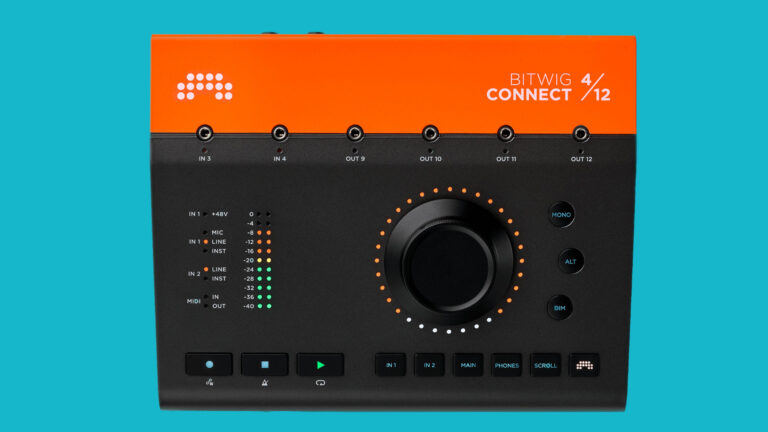
“Connect 4/12 is a compact brute of a bus-powered box that moonlights as CV bridge, transport controller, and a precision dial.”
It seems that software companies (in the music space, and elsewhere) keep jumping the fence into hardware. Part of it is surely profit motive; but beyond dollars and cents, there are benefits to owning more of the user experience and removing points of friction.
We’ve seen it with Ableton’s Push, and more recently with Move. Native Instruments has done it in the studio with Maschine, and for DJs with the Traktor controller line. So, I’ll admit to being both surprised and unsurprised to see Germany’s Bitwig join the fray.
And Bitwig, the quietly relentless Berlin-based DAW-maker that’s flown under the radar for years, has stepped into the ring in an equally quiet, but no-less compelling way with the Connect 4/12. It doesn’t just add another interface to the pile; it’s a stake in the ground for a more controlled end-to-end experience for the loyal users of the Bitwig Studio DAW.
In practice, the Connect 4/12 is a compact brute of a bus-powered box that moonlights as CV bridge, transport controller, and a precision dial for whatever you’re tweaking at the moment. That combo makes it feel less like another anonymous interface, and more like a daily driver for synth-forward producers.
The Basics
On paper, the Connect 4/12 is exactly what the name suggests: a four-mono-in, 12-mono-out audio interface, but the split is an interesting one. You get a single combo XLR/TRS suitable for mic, line, or instrument signals (with support for 48V phantom power). A separate balanced TRS that can switch between line and high-impedance instrument levels. Two additional ins on the top panel. Six TRS outs on the back. A stereo TRS plug on the back that consumes two of the outs (to give you left and right, of course), and is designed for stereo headphones. Then, four more outs on the top.
But the trick up Bitwig’s sleeve is a nod to the company’s long-standing embrace of modular synth users; the top panel ins and outs double as DC-coupled CV connection points to marry up the world of analog modular sound generation, and the digital world of the modern DAW.
Lastly, you’ll find proprietary in and out connections for MIDI, and a USB-C connector for computer connectivity and power. The Connect 4/12 is class-compliant; on macOS and Linux it’s plug-and-play, with an ASIO driver provided for Windows users. It uses highly respected AKM A/D D/A converters, and is designed to provide clean connectivity worthy of any project.
The headline workflow feature is the 360-degree, touch-sensitive main dial with six mode buttons. In its standard mode, it does some typical things like set input gains, adjust speaker and headphone levels, etc. In its native, Bitwig-specific mode, its bag of tricks expands a bit farther. Transport controls live up top on the unit, and loopback plus direct monitoring cover streaming and zero-latency needs.
Hands-On
I’ll confess that Bitwig is not my daily driver in the DAW department… and that puts me at a bit of a disadvantage, I suppose, in truly plumbing the depths of the Connect 4/12. But regardless, my first impression was that the preamp’s usable gain range is generous, and the noise floor stayed nicely managed. Headphone amp volume was more than adequate for my usual personal-monitoring choices. All the controls felt solid and smooth, matching the sense of the build you get from merely handling the hardware. The choices Bitwig made in what the Connect 4/12 offers were sensible and added true utility without fluff.
While I do have analog synths on hand and genuinely love using them, I’ve not stepped a toe onto the slippery slope of modulars generally, or CV control, specifically, but I can immediately understand the benefits of using the Connect 4/12 for those that have. Tailored specifically for use with Bitwig, the two DC-coupled inputs and four DC-coupled outputs, right on the front, make it a breeze to marry up traditional analog hardware with the modern reality of music production.
Bitwig Users Get Outsized ROI
With the Connect 4/12 set to its native Bitwig mode and matched up with the software, the unit really comes to life. Hover a parameter in Bitwig Studio and the big dial becomes a first-class controller for it, with high resolution and helpful LED color mirroring. Lock a parameter with a quick double-tap and keep moving. Automation-writing feels unusually deliberate; you’re sculpting curves with your fingertips instead of batting the mouse around. And the MCU-protocol transport means the core play/stop/record muscle memory transfers to other DAWs when you’re not in Bitwig. Still, the symbiosis here is clearly designed for Bitwig lifers and the Bitwig-curious.
Some Highlights
A few things I appreciated in my time with the Connect 4/12:
- The dial is super-precise. Touch sensitivity plus high resolution means you can do surgical moves on a filter cutoff or threshold without overshooting. The LED ring reflecting target color sounds like a gimmick until you’re working fast; then it’s a lifesaver.
- Monitor control is “one-tap obvious.” The unit makes flipping monitor settings without thinking. Your ears stay in the music, not the menu.
- Front-panel CV/audio jacks keep the creative loop tight. There’s no fumbling around behind the desk or whatever just to make some basic changes.
- Software ties that bind. Gain states can be stored with your Bitwig project, so a session opens with things intact; no scribbling settings on sticky notes.
That said, four analog inputs can feel tight. Depending on your use cases, you might end up feeling like you don’t have enough inputs, but then again, I’m used to using an 18/20 interface day-to-day. But for a synth-first, desktop-centric workflow, the 4/12 split is likely to serve you well.
Conclusions
It’s clear that the Bitwig Connect 4/12 is not trying to win a data-sheet showdown. Instead, it’s making a different argument: that your interface can and should be the fast lane between ideas and finished audio, especially if you live in a hybrid world of a DAW combined with CV-driven analog synths. The I/O mix is pragmatic, the CV is serious, and Bitwig Mode pulls the DAW into the tactile realm without the learning curve of a full control surface. If you’re a producer who values quick decisions, clean sound, and hands-on control (and especially if Bitwig Studio is part of your universe), this little metal slab earns the real estate.
At presstime, the street price hovers just under $600, which feels fair given the monitor controller functions and tight DAW integration. If your needs skew toward many simultaneous mic inputs or digital expansion, look elsewhere. But for synth-forward composers and sound designers, Connect 4/12 lands in the sweet spot between interface, controller, and CV nerve center – and it makes the whole setup feel more alive.