

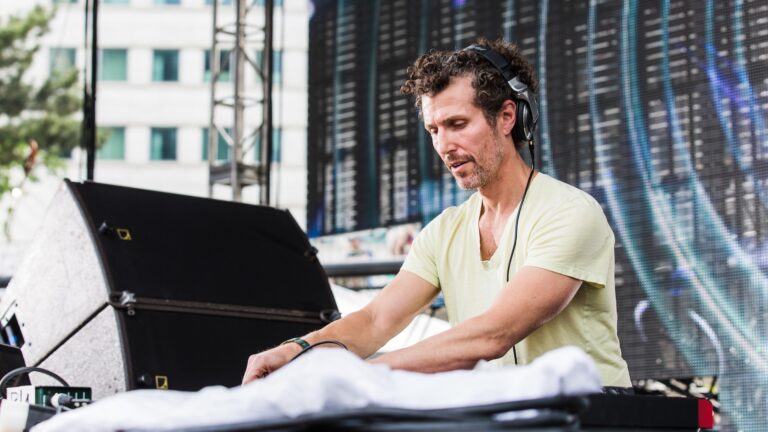
We’ve been writing about Josh Wink since the mid-1990s, when the Philly-based DJ/producer enjoyed a succession of American club/rave hits, which curiously were also pop hits in Europe. Indeed, with their mélange of electronic stylings – acid, house, techno, breaks – mad tracks like “Higher State of Consciousness,” “Don’t Laugh,” “I Am Ready,” and “Are You There?” are now considered classics and Wink continues to tour the world, playing clubs and festivals alike.
Recently, Wink’s Ovum Recordings has released “607 Sessions,” a new archival series whose the initial output is two versions of “Realize,” an rave-era fave that never found its proper release. A manic, late-night track of swirling intensity – with a tingly remix even more deftly disorienting – “Realize” takes you back to the early ’90s warehouse scene, where underground DJ/producers were left to follow their muses – and the dancefloor denizens weren’t on their phones. We caught up with Wink, 55, to discuss his latest musical moves and lot more.
DJ LIFE: Tell us about the “607 Series” of releases – what’s the vision? And what can we expect from the series?
Josh Wink: The “607 Series” began when I discovered a collection of DAT tapes with unreleased music. I had been searching for certain tracks for years, which were either lost, stolen during a studio theft, or damaged in a flood. Surprisingly, I found most of them. Matt [Brookman], Ovum’s label manager, kept pushing me to release them, even though I was hesitant because the music is over 30 years old. He’s been the driving force behind the series. The series is named after the street number of the house where I used to live. My small bedroom studio was there too, where I created much of my early music, like “Meditation Will Manifest,” most of my work on Nervous Records – “How’s the Music,” “Don’t Laugh,” Left Above the Clouds LP – “Higher States,” and Size 9’s “I Am Ready.” You can expect music that sounds strangely similar to what other producers are releasing now, but it was originally made between 1993 and 1996.
DJ LIFE: And what’s the story of resuscitating “Realize,” a track that was thought to be long-lost?
Wink: Yes, I thought it was lost, stolen, or damaged in a house flood. Then I found a bunch of DAT tapes from my early years that were stored in a “safe place,” yet a location I had forgotten to check. And it seems as though I moved them before the theft and flood. Lucky me! I freaked out when I found them!
DJ LIFE: Do you remember how you originally made that track? What was the process?
Wink: I know I didn’t use VST or plug-ins, as they weren’t available at the time. I used an Apple Mac computer running “Master Tracks” as my sequencer, and utilized my Roland 909, Akai S950 sampler, TB-303, Roland MKS-80, Electro-Harmonix Bass Micro Synthesizer, and a hand-built filter box by Fred Giannelli. I sampled my voice, a couple of things from the MKS, and did a live jam, while recording to DAT.
DJ LIFE: For the young DJ/producers out there, can you explain how you were making your tracks back in the pre-digital, pre-plugin world?
Wink: Live jamming, with my hardware outboard gear, tweaking and mixing live on the fly. That’s what it was about… not a lot of computer animation… all done live. Push play, record… mistakes and all. That’s how it was, and the beauty of the final outcome.
DJ LIFE: What analog pieces did you have at the ready back then?
Wink: I had a lot of gear at that time, as I started collecting in 1991-92. As for Roland units, I had a Juno-106, Jupiter-6, SH-101, two TB-303s, JD-800, SH-09, TR-909, TR-808, TR-505, R-5, MKS-80, and a JD-990. I also used a Moog Source, Casio RZ1, Akai S-950, Mackie CR1604 Mixer, Sequential Circuits Pro One, and a Yamaha TX 81Z.
DJ LIFE: With that gear, how long did it take to make a track you were satisfied with?
Wink: Tracks never had “times” or “rules” on how they were finished. It just happened organically. Like production today, it sometimes takes a couple of hours or a couple of weeks to complete a track, many years later. It depends on where my head is and how my creativity is flowing. For example, “Don’t Laugh” took me one night, whereas “Higher State Of Consciousness” took me a little more than two weeks. Often, I would come up with ideas quickly, only to get stuck later. So, I saved them to a floppy disk, wrote down the settings and parameters in a studio journal, and returned to them at a later time, when I felt better.
DJ LIFE: For younger folks who love techno, acid, house sounds, etc., what would you tell them about the differences of the electronic music scenes now and then?
Wink: The main difference is that you don’t need a lot of money or expensive hardware gear to produce music nowadays. You don’t need to have a studio to record in, either. Back then, if you didn’t have access to hardware gear, outboard gear, or a studio, you couldn’t record everything. It was not possible to make this kind of music. Additionally, there was no internet, making it more challenging to get music heard.
DJ LIFE: You can make the wildest tracks for the most underground settings, but you always struck me as a very grounded guy who just happened to make music for a scene that was often anything but grounded. I know that you’ve always have a wide range of tastes – what was your original attraction to electronic-dance music?
Wink: I was a mobile DJ at 13 and then went on to explore more. So, I started going to specialty record shops and got immersed in music of all sorts from different record stores. That’s how I “got the bug” by jumping into the music and living solely for this fantastic scene.
DJ LIFE: Looking back at the time of your first releases, the DJing you did then and the places you played, what does it all look like now to you?
Wink: It was a special and naive time – new, fresh, exciting. Nobody ever heard sounds and genres that were sprouting up like wild daisies. And the places this music was played were unique, but on a much smaller scale than today. It was something new, and it’s tough to put into words. But I have fond memories of playing in small rooms, warehouses, and raw clubs, with a sound system, a fog machine, and really no lights. It was raw.
DJ LIFE: What’s one thing that young DJs wouldn’t believe about the gigs you played back in the day?
Wink: DJs were often not seen. They were placed in corners or at the back of venues. There weren’t elaborate lights or sound systems – just crowds of people dancing, sweating, jacking with no phones or any other distractions. It was pure musical therapy!
DJ LIFE: There was a time when the music that was playing at underground clubs/events wasn’t so easily divided into slots… if you wanted to go to an underground party, you might hear breaks, 4/4, trancey elements, hard house, soulful sounds, pre-hardstyle tracks, d-n-b, kinda everything… and people pretty much went for it. What do you remember about those parties?
Wink: It was all the parties. The scene, the music was fresh and changing so quickly. New forms and styles of music were being introduced at such a fast pace. Creativity was paramount. I used to play the whole night – from 9 p.m. to 4 a.m. The raves created the multi-DJ guest spot, where before the DJs would play the entire night by themselves. So, you had to be diverse and know your music, playing for and to diverse groups of people who went out to the clubs – white, black, gay, straight, brown, old, young. It was a truly mixed scene back in the 1980s. Amazing.
DJ LIFE: As a DJ today, how are you connecting with the modern audiences and what connects with them to your music?
Wink: It’s becoming more difficult for me, as I believe that attention spans and genre-specific crowds are becoming more prevalent and less open-minded. Using all my years of knowledge and experience, I try to entertain and educate crowds with diverse music. What’s difficult is that people tend to prefer one style of music, and events and clubs often only play that one style. DJs are finding it harder to be diverse and creative, which frustrates me. But I focus only on what I can control and create – my unique sound of Josh Wink-inspired production and DJing style. I love taking chances, even if it’s challenging, because that’s what it’s all about for me: creativity, open-mindedness, and taking risks.
DJ LIFE: Your three all-time favorite DJs and why?
Wink: Ron Hardy was a significant influence on me and countless others, showcasing the diversity of house and techno from Chicago. John Peel, a U.K. radio DJ, introduced me to many unique musical gems through his BBC radio show. It wasn’t only electronic music that I was into, and he was great for opening my mind to everything. Richie Hawtin… contemporary techno/house DJ and producer who opened not only my eyes, but the whole scene of DJs worldwide on how you can combine outboard gear, computers, and other tools to present music in fresh and uniquely creative ways… not only relying on vinyl… opening up my DJing mind to think outside the box, and create new music out of existing music, in whatever form.
DJ LIFE: What are three favorite places to play?
Wink: Anything in Portugal. Most anything in Japan. Playing in my hometown of Philly.
DJ LIFE: What keeps you going these days and what can look forward to from you in the near future?
Wink: A continued passion for the music and scene, even though it’s completely different than it used to be, including the fact that I’m an older man now!
DJ LIFE: What are three tunes that are always “in the box” for you at all gigs – something that you might play at any time.
Wink: The three tracks are mine. “Higher State of Consciousness,” “Don’t Laugh,” and “I Am Ready.” These three tracks bring happiness and enjoyment to both old-school heads and new-school clubgoers. They have stood the test of time and continue to create memories after being released 30 years ago. And it’s a truly blessed feeling to say this.
DJ LIFE: How have you managed to keep the Ovum Recordings label going? Is there a key to longevity and success for labels in the modern age?
Wink: Yes, 31 years! Crazy. It’s a labor of love. Very challenging and difficult – but important to me. We tend to release music that we feel in our “hearts” rather than sign music based on trends. Our music from 30 years ago still sounds relevant and contemporary today! That’s something.