

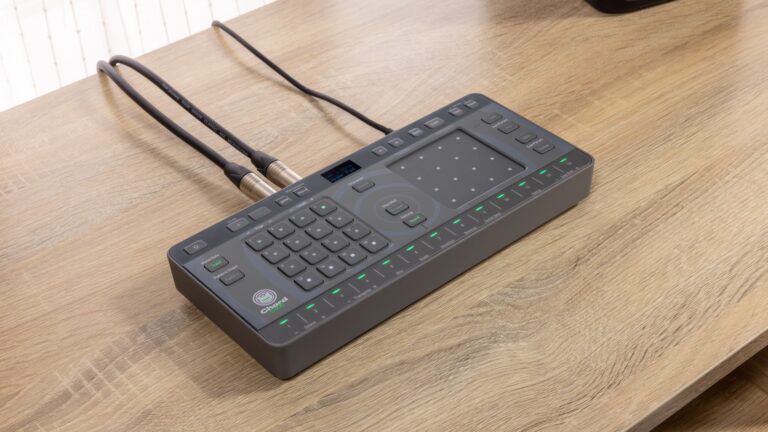
“[The Chordcat is] one of the more intriguing, and unexpectedly enjoyable little creative devices I’ve used in quite some time.”
Over the past decade or so, one of the most interesting developments in electronic-music production has been the steady rise of “idea machines.” These are tools designed not necessarily to finish an entire track, but to spark one; to generate grooves, melodies, and harmonic structures quickly enough that inspiration doesn’t evaporate before you can capture it. Devices like grooveboxes, portable sequencers, and sketchpad-style instruments have increasingly become part of the modern EDM workflow, complementing traditional DAWs rather than replacing them.
AlphaTheta, the new name of what was formerly Pioneer DJ, has occasionally ventured beyond the DJ booth and into music-production hardware. Longtime followers will remember earlier entries under the TORAIZ name like the SP-16 sampler and the SQUID sequencer. The TORAIZ Chordcat represents a return to that territory, but with a very different angle. Instead of focusing primarily on beats or synthesis, the Chordcat is built around harmony, specifically, the generation and exploration of chord progressions.
That alone caught my attention. As someone who produces a fair amount of EDM in my home studio, I’ve always been fascinated by tools that make harmonic experimentation easier. And after having a Chordcat in my studio for several months, I can say that it’s one of the more intriguing, and unexpectedly enjoyable little creative devices I’ve used in quite some time.
First Impressions
The first thing that struck me about the Chordcat when I pulled it from the box was just how compact it is. The device weighs less than a pound, and is small enough to slip easily into a backpack or gig bag.
Its flat, minimalist design feels almost like a cross between a groovebox and a game controller, with a clean layout of buttons, a small screen, and an XY pad for navigation and effects control. The build quality is solid, and the controls have a satisfying tactile feel. It’s clearly intended to be portable, and it can run either from USB-C power or from six AA batteries, making it easy to use away from the studio desk.
Under the hood, the Chordcat is an eight-track groovebox with a 16-step sequencer capable of expanding to 128 steps per pattern. Each track can host its own instrument, and the device includes 145 sound presets and 16 drum kits covering synths, basses, pads, and other basic production staples.
But the star of the show, and the reason this device exists in my view, is the Chord Cruiser system. In essence, it’s a chord-generation engine that can navigate through a huge database of harmonically compatible chords. The system can propose up to roughly 110,000 possible chord combinations, presenting them in a way that allows you to quickly audition and select progressions.
In other words, rather than forcing you to program chords manually or rely strictly on theory, the Chordcat encourages you to explore harmony interactively. It’s a clever concept.
Hands On
After several months of using the Chordcat in my studio, I’ve come to think of it less as a groovebox and more as a creative catalyst.
For most of today’s mainline music genres, as well as many forms of EDM, chord progressions can serve as the emotional backbone of a track. A simple progression is the foundation for countless tracks. But the magic often comes from the color added around those core harmonic movements. That’s where the Chordcat gets interesting.
If you dig into a little music theory, most of what we call “harmony” still starts with simple triads, major or minor, built by stacking intervals (typically thirds) above a root. From there, the “fancy” chord names often come from one of two moves: Either you extend the chord by adding extra tones (7ths, 9ths, and beyond), or you swap out the third for a neighboring tone. That’s where the classic sus2/sus4 move that shows up constantly in guitar charts because it creates tension and openness without changing the root/fifth foundation.
That’s exactly the vibe I got from Chordcat’s Chord Cruiser suggestions. It doesn’t just hand you vanilla major/minor blocks; it routinely throws in suspended chords and other popular “color” variants alongside the more obvious 7th/9th extensions. They’re the kinds of options that can look harmonically exotic on the screen, but often amount to tasteful seasoning on otherwise familiar progressions.
And frankly, that’s part of the appeal: in EDM contexts, where you might want a progression to feel a little more emotional, a little more sophisticated, or just less predictable, those suspended and extended options can give you lift and movement without forcing you into full-on jazz theory or a bunch of finger-twisting chord voicings.
In a typical session with the Chordcat around, I might start a track by building a drum groove inside my DAW, usually in Ableton Live, and then reach for the Chordcat to experiment with harmonic ideas. With the key and scale set, the Chord Cruiser suggests compatible chords that can be auditioned instantly. The workflow encourages exploration: tap through possibilities, find something interesting, record it, move on.
One evening, for example, I stumbled into a progression that felt perfect for a melodic house track I was sketching out. On paper, the chords were labeled with fairly elaborate names, but when you listened to them in context, they were essentially just familiar minor and major movements with a little extra harmonic flavor. The Chordcat made that discovery process fast and fun.
Another practical use I found was generating chord beds for breakdown sections. EDM breakdowns often rely on lush pads and evolving harmonic movement, and the Chordcat’s ability to wander through related chords made it easy to audition different emotional directions without stopping to think too hard about theory.
AlphaTheta also provides a companion utility called Chordcat Manager, which allows patterns created on the device to be exported as MIDI into a DAW. That workflow makes it easy to use the Chordcat as a harmonic sketchpad while letting your favorite software instruments handle the final sound design.
Conclusions
After spending so much time with the AlphaTheta TORAIZ Chordcat in my studio, I’ve come away genuinely impressed, and perhaps a little surprised by how often I’ve reached for it. Its greatest strength lies in its ability to encourage harmonic exploration without demanding deep theoretical knowledge. By presenting musically compatible chord suggestions and letting you move through them fluidly, it creates a kind of creative feedback loop that can lead to interesting ideas very quickly.
For EDM producers, in particular, that’s valuable. Dance music often lives or dies on the strength of its chord progressions, and the Chordcat provides a fast way to discover new ones, or to add subtle harmonic color to familiar progressions.
At a street price in the neighborhood of roughly $300, it’s also fairly approachable for a dedicated creative tool like this. Considering its portability, sequencing capability, and the sheer number of harmonic combinations it can generate, it occupies a unique niche in the modern production toolkit as an engaging little device that can spark inspiration when you need it most.