

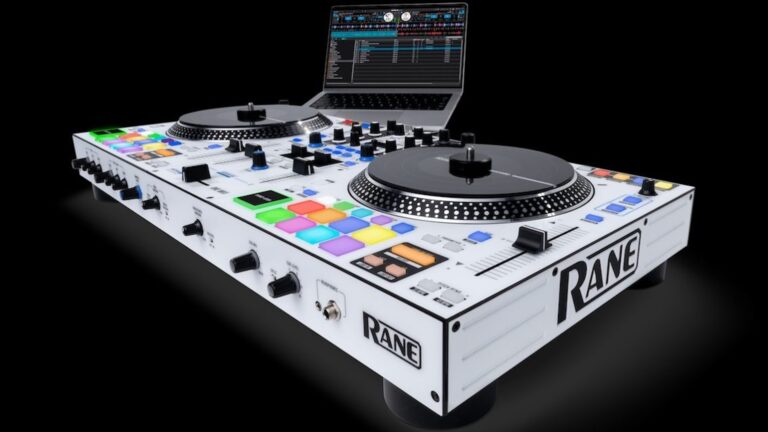
“Making big waves in the DJ technology landscape, the Rane ONE MKII promises to be the next evolution in this lineage.”
I cannot believe how fast time flies. It seems like just yesterday when I was covering the original Rane ONE controller. (It was 2021, folks.) But I remember being really excited… controllers with spinning platters are just so cool. They combine the tactile feel of playing on vinyl records with the convenience of digital music.
For many years, the closest way to play digital music with the feel of a turntable was to use a digital vinyl system (DVS). With a DVS setup, traditional turntables spin control vinyl – a vinyl record etched with a special signal. The signal is then read by either an external DVS box or a specially equipped mixer or controller that registers the signal of the control vinyl and translates that into manipulation of a digital file.
Of course, DVS systems became quite popular, and Rane was, for many years, on the forefront of such technology. More recently, a wave of media players and controllers with their own spinning platters hit the market, making big waves in the DJ technology landscape. Now, the Rane ONE MKII promises to be the next evolution in this lineage. Let’s dive in:
What’s New?
There are a few key differences on this second generation of Rane’s ONE unit, as compared with the first generation. For starters, there’s now a built-in effects section with a small text display at the center of the mixer section. This means external non-software inputs can now benefit from hardware effects.
The second big update is the inclusion of dedicated physical buttons for controlling stems (the ability to separate a track into individual vocal and instrumental portions). As we know, Stems have become a dominant force in the open-format world, and it makes a lot of sense to see them included here.
Build & Look
Rane products have a well-deserved reputation for being built like a tank, and the ONE MKII is no exception. It weighs just under 25 pounds and feels rock-solid. The unit is damped from vibrations and harshness thanks to four beefy rubber feet at each corner. The controller is 26.5-inches wide and 13.6-inches deep.
It came shipped to me wearing a striking white color scheme. The vinyl platters are a deep black, which provides a nice contrast with the white. Personally, I would have preferred a darker color scheme, but the white is definitely eye-catching.
The Layout
Layout-wise, the ONE MKII shares a lot of DNA with the original version. There are two deck sections each flanking a central mixer section. The MVP of each deck section is easily the 7.2-inch platter, complete with real vinyl on the top. Although smaller than a full-size vinyl turntable, they offer a solid and tactile feel. DJs accustomed to spinning on larger platters will feel right at home in no time.
Below each platter are eight RGB performance pads that can be switched from hot cues, saved loops, roll mode, sampler, and (new for the MKII) stems control. Carried over from the previous generation, there are loop controls, a long pitch fader, slip mode, and a way to control how long it takes the spinning platter to stop. Gone from the first generation is the touch-sensitive strip that you can use to quickly fan through the track.
The mixer section also benefits from some updates. There’s now a small black-and-white, text-only screen that supports the new built-in effects section. There’s a three-band EQ for each that can also accommodate stems control as well. The effects trigger paddles from the previous generation also make an appearance here.
Pulling a paddle down temporarily activates an effect, while pushing the paddle up locks it in until the paddle is returned back to neutral. Personally, I’m a big fan of effects paddles – they’re so satisfying to use.
The two up faders and the crossfader both feel outstanding to use. No surprise there. This might be a controversial take, but I truly appreciated the simplicity of the original Rane One. I think the mixer section of the MKII perhaps risks having a little too much going on, and there’s definitely a learning curve.
At the front of the unit, there are controls for the two mic inputs. It’s cool to see individual two-band EQ controls for each input. There’s a knob to control the sampler volume, and knobs to control the contour of both up faders and the crossfader.
Finally, at the far right, there’re the usual two sizes of headphone jacks, along with the usual cue mix and level control. At the back, there are two mic inputs on combo XLR/TRS jacks. One of the mic inputs can be swapped for an auxiliary input on RCAs. There are two switchable line/phono inputs for each deck (the mixer can be used as a dedicated hardware mixer), along with a phono ground.
There is a main output on RCAs and XLRs, and there’s a secondary booth output on XLRs as well. There are two USB type-B inputs for connecting the controller to a computer. There’s also a motor torque switch on the back.
(Personally, I wonder if the motor torque switch should have been somewhere else, as it might be hard to reach all the way at the back of the unit next to the inputs/outputs.) Also on the back, there is a fan, an IEC connector for power, and an on/off button.
In Use
In my testing, I found the motorized platters offer excellent control. Everything responds well and with ultra-low latency, even when doing scratching, backspins, and beat-juggling. Turntablism routines rise to the next level with dedicated stems control on the hardware. This is a premium piece of hardware for DJs who want what could be the ultimate weapon in the open-format battle.
Some of its features might go unused, but the build quality, sound fidelity, and control feel is top-tier. Competitors include the Pioneer DJ DDJ-REV7 or even the Hercules Impulse T7, which both have spinning platters. DJs should also seriously think if the drawbacks of motorized platters are worth it for them. Motorized platter controllers are heavy and expensive, but they do offer a unique way of interacting with the music.
Current users of the original Rane ONE should also look at the new features on the MKII and see if their inclusion justifies the upgrade for them. For some, dedicated stems control is a must-have feature. Regardless, the Rane ONE MKII ($1,699 list) seems like more than just a DJ controller – it feels like a powerful creative remixing tool.