

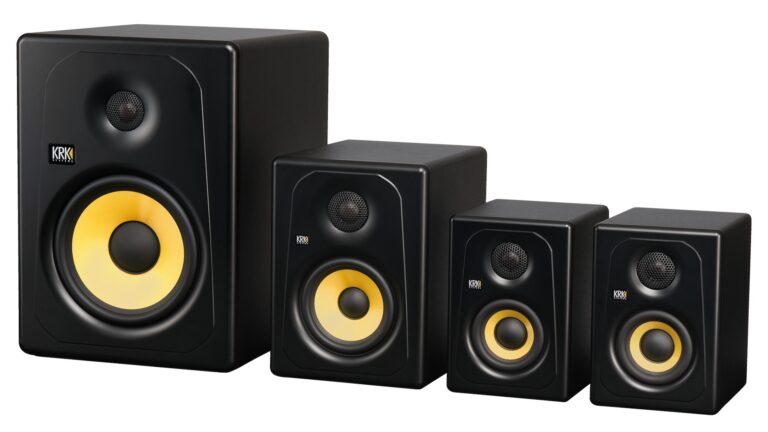
“For routine use and sketching out musical ideas and concepts in rough form, the Kreate 3 is a great choice.”
One of the notable trends in music production that I’ve witnessed in the past few years is the emergence of truly capable solutions for developing musical ideas and concepts outside of the conventional studio environment. It’s hard for me to identify the original source of the trend, but from early entries, like Apple’s GarageBand for iOS devices, to more recent additions, like Ableton Note, it’s clear that we have some innovative software as the foundation. And with devices like the Yamaha Seqtrak that I reviewed previously, we also have interesting hardware to aid the process these days. There’s never been a better time, honestly, to dip a toe into electronic-music production.
Coming along for the ride, then, it’s no surprise that studio-monitor makers have begun to offer solutions for the on-the-go market as well. Not long ago, I reviewed the KRK GoAux4 Mobile Monitoring System, which is well and truly designed specifically for portable use, with an included go bag.
KRK’s new Kreate Series is along similar lines, providing active monitors in three different sizes and price points. While not targeted for portable use like the GoAux4s, the Kreate Series is well-suited to situations that lie outside the studio, and, hence, can’t justify the investment in a high-end studio-monitor solution.
In fact, it’s the affordability of the Kreate Series that sets it apart from other entries in the KRK product family. When you add in the convenience of Bluetooth support, the Kreate Series becomes a strong choice for bedrooms, home offices, or other environments where you may need better-than-average sound for music-making, while also having solid output for streaming and general audio as well.
First Impressions
For this review, KRK loaned the Kreate 3. While the rest of the Kreate series – Kreate 5 and Kreate 8 – are sold singly, the Kreate 3 is sold as a ready-to-use pair for just under $180. (The Kreate 5 is sold in singles for under $170 each, while the Kreate 8 runs just under $230 each.)
Like the GoAux4 system I reviewed previously, the Kreate 3 is more a computer-speaker-like solution, with the amplifiers and connections only on one side (the left), with a satellite speaker tethered to it (the right), with no inputs of its own. (The 5 and 8 models are self-contained, like traditional studio monitors.) I confess that I don’t prefer this configuration, but I understand why KRK has done it this way, especially for the junior-most model in the series.
Inputs include TRS, RCA, and an 1/8-inch stereo aux, which is great for a phone or tablet. And, as mentioned above, there’s Bluetooth for your convenience as well. You’ll also find an overall gain control, and both HF and LF adjustment boost/cut switches.
The speakers are quite compact and, of course, have KRK’s trademark look with yellow cones. But, how do they sound?
In Use
The KRK Kreate 3 pair provides decent sound when one considers the form factor. Delivering a total of 65 watts (both sides combined), the three-inch main driver performs admirably, but perhaps predictably.
These are two-way units, so the ¾-inch tweeter pushes the top end to a rated 33 kHz. But the low end? Here’s where that “predictably” part comes in: The low-end response is just 70 Hz. That’s really just not particularly suitable for pro-level production work that involves deep, thumpy bass, but then, nobody’s going to be doing final mixing or mastering on a monitor with a three-inch main driver.
For routine use and sketching out musical ideas and concepts in rough form, I think the Kreate 3 is a great choice. They sound deceptively good, honestly, as has been my experience with small-driver KRKs over the years; the company simply knows how to do small-form-factor speakers pretty well.
I wouldn’t personally attempt to use the Kreate 3 units for serious mixing and mastering work; but in testing, I did happen to pair them up temporarily with my usual studio subwoofer, which is normally connected to a pair of KRK V-Series 4 monitors as the “A” part of my A/B set-up (the “B” side being a pair of monitors with much larger drivers, and no sub).
The result? Honestly, not bad, but a little wanting compared to my usual monitors in that configuration. But the comparison is unfair; those V-Series 4 monitors I like so much go for just under $420 each. So, I’d have expected the qualitative differences I heard, considering a set of them will set you back $660 more, compared to the Kreate 3s.
One other minor point: the cable connecting the left main unit to the right satellite unit is only six-feet long, which is a bit wanting for me. In two locations where I wanted to set them up and leave them for a bit, the cable simply wasn’t long enough to position them where I needed them. And the cable has a proprietary connector, meaning there’s no realistic way to extend that.
In any case, I certainly appreciate KRK lowering the bar for pricing with studio monitors, especially in the current economic climate. If you want to do more serious work, but funds are tight, definitely consider the Kreate 5, or better still, the Kreate 8, as affordable, more compelling options. (I did not, however, evaluate either of the larger models.) That being said, if you’re truly serious about your music creation, mixing, and mastering, you’ll still need to invest considerably more to get the punch, power, and frequency response that serious work requires. That probably means a subwoofer, room treatments, and everything else that comes along for the ride.
But, as I already said, that’s not where the Kreate 3 is designed to play. I’ve been using them in my home office for general music listening, Zoom sessions, video editing, and basic editing of music beds for those videos, and they’ve been performing quite well in that role. For the price? They’re truly hard to beat.